 Patrick Buckley
f4fd7e1f67
Patrick Buckley
f4fd7e1f67
* fix(security): classify outbound addresses by what they reach (GHSA-wm4f-79pw-pfr9)

Five guards screened outbound URLs and each hand-rolled its own address
normalization and policy tests, so each had a different hole. An IPv6
transition address carries an IPv4 destination in its low bits and
`ipaddress` classifies the wrapper, not the destination: 64:ff9b::a9fe:a9fe
reports is_global because 64:ff9b::/96 is global unicast, while a NAT64
gateway routes it to the cloud metadata endpoint. CGNAT (100.64.0.0/10) is
neither is_private nor is_global, so a denylist built on is_private missed
it with no gateway involved at all.

Add turnstone/core/ip_classify.py as the single classifier. One function
returns exactly one policy lane — PUBLIC, PRIVATE (operator-approvable) or
NEVER — and every guard branches on the lane rather than re-deriving it.
Two overlapping booleans would make a verdict depend on which one a caller
tested first; several addresses are simultaneously globally routable and
metadata-reaching.

- Decode transition addresses per RFC 6052 §2.2 (NAT64 well-known and
  local-use prefixes, 6to4, Teredo, IPv4-mapped, IPv4-compatible) and judge
  them by the IPv4 they reach. The local-use prefix does not say which
  layout its gateway uses, so every length it can carry is decoded and the
  worst result classified.
- Share hostname resolution too. The five copies had already drifted on
  which failures they caught, and getaddrinfo raises UnicodeError — not an
  OSError — from the IDNA encoder.
- Resolution failure is a refusal, not a pass: the fetch resolves again, so
  an authority answering the guard with SERVFAIL and the fetch with an
  internal address would otherwise switch the guard off for that hop.
- Screen every redirect hop in every mode. allow_private_origin widens which
  lanes are acceptable rather than turning screening off, and the permission
  is revoked after any hop that is not wholly private.
- Cleartext http is allowed only for a hostname that RESOLVES to loopback.
  *.localhost is ordinary DNS, and trusting the name put an OIDC token
  exchange on the wire in the clear.
- Screen doctor and console-probe URLs through the classifier. Both used a
  host.startswith("169.254.") string test that never resolved, so any DNS
  name pointing at the metadata service passed and its body was returned to
  the model.
- Add known vendor metadata prefixes the stdlib does not flag, and place
  deprecated IPv6 site-local outside the public lane.

The operator's private-network opt-in still admits the whole home lab,
including IPv6 loopback, CGNAT and split-horizon hosts. Metadata,
link-local, multicast, unspecified and reserved addresses stay refused
regardless of the opt-in, including as a redirect target from an approved
private origin — the settings help and docs now say so.

Reported by @tonghuaroot.

* fix(security): close Azure/Oracle metadata gap and restore dual-stack origins

Review follow-ups on the address-classification rework.

Azure's host-agent endpoint (168.63.129.16) and Oracle Cloud's metadata
endpoint (192.0.0.192) sit in ordinary unicast space, so the stdlib reported
them as globally routable and both classified PUBLIC — reachable with no
opt-in at all, a worse position than the RFC 1918 host beside them, and
directly contradicting the "metadata stays refused even with the opt-in"
guarantee the settings help and docs now advertise. Both join the shared
vendor list.

Revoking the private-hop permission on the ORIGIN hop broke the case
`_screen_tool_url` deliberately admits: a dual-stack or split-horizon
home-lab host answering with both a LAN and a public record was approved,
then refused on its own `302 /login` — one hop was all it ever got. Track
the approved HOST instead, so redirects that stay on it remain covered while
a redirect to any other private host is still refused once the chain is no
longer wholly private.

Also:

- Try several registry candidates for the collector-scope probe instead of
  abandoning it when the first is unresolvable, which also stopped a healthy
  registry from logging as malformed.
- Bound the probe's name resolution with an explicit timeout matching the
  2s the httpx connect deadline used to provide; it runs before the console
  lifespan yields and getaddrinfo has no timeout of its own.
- Route doctor and the console probe through `web.screen_url` rather than
  keeping a third and fourth copy of parse/resolve/classify/fold, which had
  already diverged on default port and empty-hostname wording. An empty
  hostname no longer reports as a cloud-metadata refusal.
- Give `screen_url` a scheme-aware default port.
- Stop doubling the word "hostname" in the OAuth resolution refusal.
- Correct the `_screen_tool_url` docstring: it described `private_origin` as
  requiring every record to be private, which the mixed-record decision
  reversed, and `private_block` as a property of a refusal when it reports
  the lane on the success path too.
- Make the preview tests' screening stub opt-in rather than autouse — as a
  module-wide fixture it also stubbed the tests whose subject IS the screen,
  so one of them would have passed even if screening refused everything.
  Verified the module now passes with all name resolution blocked.

* fix(security): refuse mixed-record private origins instead of exempting them

The previous commit let an approved private origin redirect to itself by
exempting its hostname from the chain-wide revocation. That exemption was
wrong three ways: it was captured once and never cleared, so a public hop
could steer the fetcher back into the approved host at a path of its
choosing — reopening the private -> public -> private bypass; it was
re-entrant across same-host redirects with fresh DNS each time, so a
self-redirecting host could walk arbitrary internal addresses; and it
matched on bare hostname, so it spanned every port on the approved box.
All three were reproduced against the parent commit, which refuses them.

Delete the exemption rather than repair it. The case it existed for — a
dual-stack host answering with both a LAN and a public record — is now
refused where it is actually decidable, in `_screen_tool_url`, with the
remedy in the message: point the tool at the LAN address directly. A
granted chain therefore always starts wholly private, so the fetch guard
needs no notion of an approved host and stays one unconditional rule.

That the accommodation could not be expressed safely in the guard is the
signal: the connection may land on either record, so approving such a host
never described where the fetch would go.

Also from the same review:

- Walk the whole service registry for a collector-scope probe candidate
  instead of the first three, and split the outcome into three log lines,
  so entries that are merely unreachable stop raising the malformed-registry
  alarm and skipping the boot check cluster-wide.
- Stop the candidate walk on a resolver timeout. `asyncio.timeout` bounds
  the await, not the work, so continuing left one parked thread per timed-out
  candidate on the shared executor.
- Move the metadata-hostname denylist into `ip_classify` and enforce it in
  `screen_url`, so doctor and the console probe inherit it instead of each
  keeping a copy.
- Drop the scheme-aware default port: a numeric service does not change
  which addresses resolution returns, and classification reads only those.
  `parsed.port` is still touched so an out-of-range value refuses.
- Correct the vendor-metadata comment, which generalized a claim true of
  Azure's and Oracle's addresses to Alibaba's CGNAT one.
- Rename a test class that was still named for the rule it no longer tests.
Turnstone






Self-hosted, local-first orchestration for tool-using AI agents. Give LLMs real tools — shell, files, search, web — and run them across your own cluster with direct HTTP routing and interactive interfaces. Your code, your models, your data stay on hardware you control: no telemetry, no phone-home.

Named after the Ruddy Turnstone (Arenaria interpres) — a shorebird that flips stones to discover what's hiding underneath.
What is a harness?
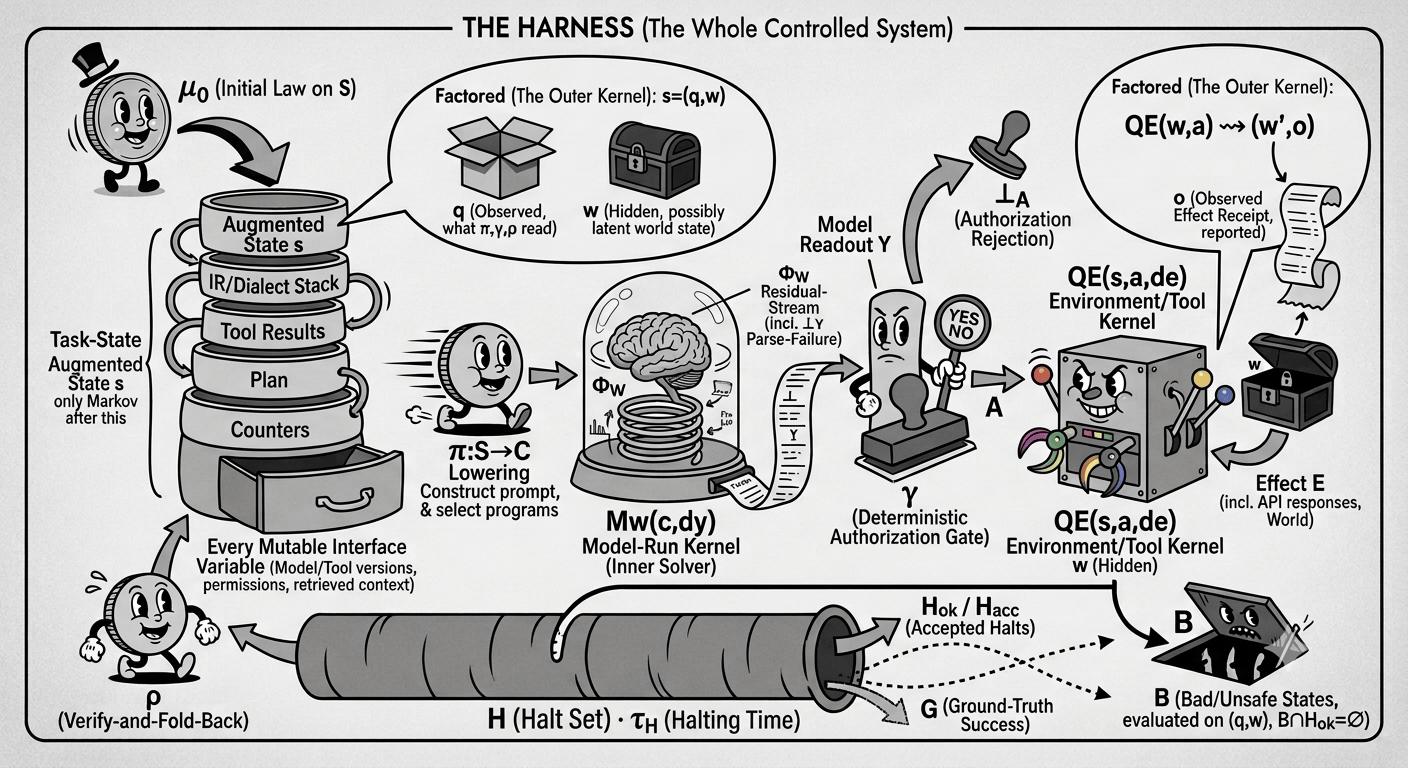
ℋ : s_{n+1} ~ T(s_n) for n < τ_H
the primer → · the formalism →
Release Tracks
| Track | Install | Docker | Description |
|---|---|---|---|
| Stable | pip install turnstone |
ghcr.io/turnstonelabs/turnstone:stable |
Production-grade. Bugfixes only. |
| Experimental | pip install turnstone --pre |
ghcr.io/turnstonelabs/turnstone:experimental |
New features. May have rough edges. |
See docs/releasing.md for the full release process.
What it does
Turnstone gives LLMs tools — shell, files, search, web, planning — and orchestrates multi-turn conversations where the model investigates, acts, and reports.
- Local-first & private — runs entirely on hardware you control, with no telemetry and no phone-home. Point it at local models (vLLM, llama.cpp) or commercial APIs you hold the keys to — your prompts and data never transit a third party you didn't choose.
- Bring your own models — OpenAI-compatible APIs (vLLM, llama.cpp, NIM), the Anthropic Messages API, and Google Gemini, mixed freely per role
- Interactive sessions — terminal CLI or browser UI with parallel workstreams
- Cluster dashboard — real-time view of every node and workstream, with a rendezvous routing proxy
- Intent validation — an LLM judge (your model) grades every tool call with a risk assessment and evidence before it runs
- MCP support — external tool servers with native deferred loading (Anthropic/OpenAI) or BM25 fallback
- Team controls when you need them — optional RBAC, SSO, tool policies, and audit logs, all stored in your own database

Quickstart
pip install turnstone

# Terminal REPL
turnstone --base-url http://localhost:8000/v1

# Browser UI
turnstone-server --port 8080 --base-url http://localhost:8000/v1

# Cluster dashboard
turnstone-console --port 8090
For PostgreSQL (recommended for production):
export TURNSTONE_DB_BACKEND=postgresql
export TURNSTONE_DB_URL="postgresql+psycopg://user:pass@localhost:5432/turnstone"
turnstone-server --port 8080 --base-url http://localhost:8000/v1
Docker
One-line install — autodetects Ubuntu/Debian, Fedora/RHEL, Arch, and WSL, installs git + Docker if missing, generates secrets, and starts the stack:
curl -fsSL https://raw.githubusercontent.com/turnstonelabs/turnstone/main/run.sh | bash
Or, if you already have Docker, clone the repo and run it yourself:
docker compose up
That builds one image and brings up a full local cluster — PostgreSQL, console,
Caddy, channel gateway, and 10 server nodes — with no .env required (it ships
with insecure dev defaults). Open the dashboard at https://localhost:8443 (Caddy
serves it over TLS with its own local CA — trust it once). Nodes boot without an
LLM; add model backends from the console UI.
For production (released images from ghcr.io, real secrets required), use the
bundled stack: docker compose -f turnstone/deploy/compose.yaml up.
See QUICKSTART.md for the install + troubleshooting walkthrough and docs/docker.md for Docker configuration.
Programmatic (SDK)
from turnstone.sdk import TurnstoneServer

with TurnstoneServer("http://localhost:8080", token="tok_xxx") as client:
    ws = client.create_workstream(name="demo")
    result = client.send_and_wait("Analyze the error logs", ws.ws_id, auto_approve=True)
    print(result.content)
Tools
Built-in tools for shell, files, search, web, memory, notifications, and autonomous sub-agents — plus external tools via MCP with native deferred loading. See docs/tools.md for the full reference and docs/mcp-registry.md for MCP configuration.
Architecture
Single-node: Client → Server (direct HTTP + SSE). No external dependencies beyond the database.
Multi-node: Client → Console (rendezvous routing proxy) → Server nodes. The console picks the target node for each workstream via rendezvous (HRW) hashing over the live service registry — pure function of (ws_id, live_nodes), no stored bucket state, deterministic across readers. A node join or drop only re-routes the keys that score highest on the affected node.
| Component | Purpose |
|---|---|
turnstone |
Terminal CLI (REPL) |
turnstone-server |
Web UI + REST API + SSE events |
turnstone-console |
Cluster dashboard + routing proxy + admin panel |
turnstone-channel |
Channel gateway (Discord and Slack adapters) |
turnstone-admin |
User/token management CLI |
turnstone-eval |
Headless measurement — scores tool-use against expected actions |
turnstone-optimizer |
Prompt/tool optimizer (UCB self-modify loop over the eval substrate) |
turnstone-doctor |
LLM-backed cluster diagnostics |
Diagrams
UML diagrams in docs/diagrams/:
| Diagram | Description |
|---|---|
| System Context | Components and external dependencies |
| Package Structure | Python modules and dependency graph |
| Core Engine | SessionUI, ChatSession, LLMProvider |
| Conversation Turn | Message lifecycle through the engine |
| Tool Pipeline | Prepare / approve / execute |
| Workstream States | State machine transitions |
| Console Data Flow | Dashboard data collection |
| Deployment | Docker Compose topology |
| Auth | JWT, scopes, login flows |
| Channels | Discord / Slack adapters + routing |
| Judge | Intent validation pipeline |
| OIDC | SSO authorization code flow |


Documentation
| Topic | Link |
|---|---|
| Configuration reference | docs/settings.md |
| API reference | docs/api-reference.md |
| Docker deployment | docs/docker.md |
| Intent validation (judge) | docs/judge.md |
| Governance & RBAC | docs/governance.md |
| OIDC SSO | docs/oidc.md |
| TLS / mTLS | docs/tls.md |
| Channel integrations | docs/channels.md |
| Console dashboard | docs/console.md |
| Eval harness | docs/eval.md |
| Tools reference | docs/tools.md |
| MCP integration | docs/mcp-registry.md |
Requirements
- Python 3.11+
- An OpenAI-compatible API endpoint, Anthropic API key, or Google Gemini API key
- Optional: Discord / Slack channel integrations (
pip install turnstone[discord,slack]) - Git LFS for cloning (diagram PNGs)
Support
Turnstone is free, Apache-2.0, and self-hosted — no paid tier, no telemetry, no upsell. If it saves you time or you'd like to help keep development moving, you can sponsor the project:
❤ Sponsor Turnstone → · one-off via PayPal
Sponsorship is entirely optional and funds maintenance, new features, and infrastructure. Prefer to contribute in other ways? Filing issues, improving docs, and pull requests help just as much.
Community
Questions, ideas, or want to show what you're building? Join us on Discord: discord.gg/Nh3bWMacaq.
License
Apache License 2.0, as of version 1.6.0. Versions 1.5.x and earlier remain under the Business Source License 1.1 they shipped with.