 posixpositive
73fb84b459
posixpositive
73fb84b459
* fix(helm): repair install-blocking template bugs

The chart could not complete `helm install` in any cluster. Three
independent faults, each hit in sequence on a clean namespace:

1. The console Deployment never set TURNSTONE_DB_URL. The console
   requires it (console/server.py exits with "Storage backend is
   required for the console") so the pod could never start. Only the
   server Deployment defined it.

2. The migrate Job is a pre-install hook but referenced the chart's
   ServiceAccount. Helm creates ordinary resources only after hooks
   complete, so the Job could never be scheduled:

     Error creating: pods "turnstone-migrate-" is forbidden: error
     looking up service account <ns>/turnstone: serviceaccount
     "turnstone" not found

   The migration talks to PostgreSQL and never to the Kubernetes API,
   so it now runs under the namespace default ServiceAccount.

3. The same Job took its config via `envFrom` on the chart's ConfigMap
   and Secret -- also ordinary resources -- so once (2) was fixed it
   failed with:

     Error: configmap "turnstone-config" not found

   The Job is now self-contained. Where it still needs the chart's own
   Secret for POSTGRES_PASSWORD, that Secret carries matching
   pre-install/pre-upgrade hook annotations at a lower weight (-3 against
   the Job's -1) so it exists by the time the hook runs.

Also wires up two values that were documented but referenced by no
template: database.external.existingSecret and database.external.sslmode.
An external database frequently keeps its password in a secret the chart
does not own (CloudNativePG, External Secrets, ...), where the key is
rarely named POSTGRES_PASSWORD, so existingSecretPasswordKey is added
alongside. sslmode is appended to the URL only on the external path.

The shared turnstone.db.env helper renders every connection value inline
rather than relying on envFrom expansion, which is what lets the hook
stand alone; the server, console and Job now cannot drift apart. Its
secret-name fallback resolves through turnstone.llm.secretName rather
than hardcoding "<fullname>-secrets", because templates/secret.yaml is
skipped entirely when llm.existingSecret is set -- hardcoding it would
point every workload at a Secret that is never created.

Verified against an external CloudNativePG cluster: `helm install`
completes, the migration creates all 45 tables, and both workloads reach
PostgreSQL over TLS. `helm lint` passes, and every referenced Secret is
either chart-created or operator-supplied, across the bundled,
bundled+llm.existingSecret, external+inline-password and
external+existingSecret paths.

Co-Authored-By: Claude Opus 5 (1M context) <noreply@anthropic.com>

* fix(helm): advertise per-pod URLs so multi-node routing works

Neither workload advertised an address peers could reach, so the console
could not talk to server nodes at all and server.replicas > 1 was
unusable.

Server nodes register in the `services` table and the console routes to
them with rendezvous (HRW) hashing: route(ws_id) picks exactly one node
and proxies to that node's advertised URL. The chart set nothing, so a
node fell back to gethostname() -- the pod name -- which nothing in the
cluster can resolve, and the console's SSE collector could never attach.

The fix cannot be the Service DNS name: that load-balances across every
replica, so traffic the router computed for node A lands on an arbitrary
pod. With three replicas that produces a steady stream of 404s through
the router's retry path. Each pod now advertises its own pod IP via the
downward API, which is unique, routable in-cluster on any CNI, and
re-registered on every start.

The console is the opposite case -- one logical endpoint behind its
Service -- so it advertises the Service DNS name via TURNSTONE_CONSOLE_URL.
That name stops at ".svc" rather than assuming a "cluster.local" DNS
domain, which is configurable per cluster.

Verified at server.replicas=3: all three nodes register distinct
addresses, and six workstreams created through
/v1/api/route/workstreams/new distribute across the ring and complete
real inference turns.

Co-Authored-By: Claude Opus 5 (1M context) <noreply@anthropic.com>

* fix(helm): use Recreate for the single-replica console

Workaround for a service-registry race, kept as its own commit so it can
be dropped if the underlying bug is fixed in the application instead.

The console registers itself under the fixed service_id "console" and
deregisters on shutdown. Under RollingUpdate the incoming pod registers
first and the outgoing pod's deregister then deletes that row. The
console's heartbeat only updates last_heartbeat -- heartbeat_service()
returns False when the row is missing and the caller discards it -- so
the registration is never recreated and the console stays invisible in
the registry for the life of the process.

Recreate orders shutdown strictly before startup. It is gated on
console.replicas == 1, since Recreate is meaningless above that and the
fixed service_id makes multiple console replicas overwrite each other
regardless.

The better fix is arguably in the application: have heartbeat_service()
re-register when its row has gone, which would make this unnecessary.
Happy to drop this commit in favour of that.

Note for existing deployments: switching strategy on a live Deployment
fails with `spec.strategy.rollingUpdate: Forbidden: may not be specified
when strategy type is 'Recreate'` because the stored object still
carries the defaulted rollingUpdate block. It needs a one-off
`kubectl patch` to remove that field. Fresh installs are unaffected.

Co-Authored-By: Claude Opus 5 (1M context) <noreply@anthropic.com>

---------

Co-authored-by: Claude Opus 5 (1M context) <noreply@anthropic.com>
Turnstone






Self-hosted, local-first orchestration for tool-using AI agents. Give LLMs real tools — shell, files, search, web — and run them across your own cluster with direct HTTP routing and interactive interfaces. Your code, your models, your data stay on hardware you control: no telemetry, no phone-home.

Named after the Ruddy Turnstone (Arenaria interpres) — a shorebird that flips stones to discover what's hiding underneath.
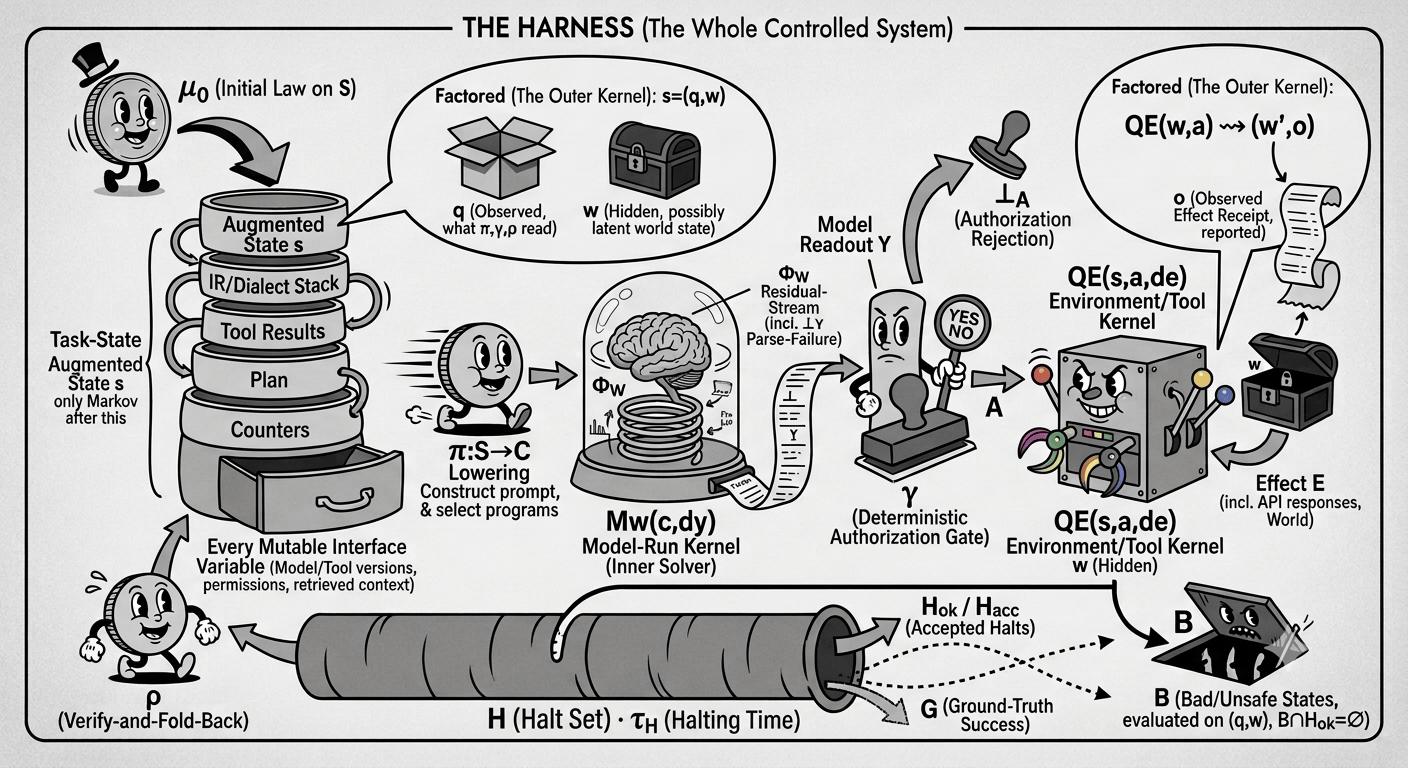
What is a harness?
ℋ : s_{n+1} ~ T(s_n) for n < τ_H
the primer → · the formalism →
Release Tracks
| Track | Install | Docker | Description |
|---|---|---|---|
| Stable | pip install turnstone |
ghcr.io/turnstonelabs/turnstone:stable |
Production-grade. Bugfixes only. |
| Experimental | pip install turnstone --pre |
ghcr.io/turnstonelabs/turnstone:experimental |
New features. May have rough edges. |
See docs/releasing.md for the full release process.
What it does
Turnstone gives LLMs tools — shell, files, search, web, planning — and orchestrates multi-turn conversations where the model investigates, acts, and reports.
- Local-first & private — runs entirely on hardware you control, with no telemetry and no phone-home. Point it at local models (vLLM, llama.cpp) or commercial APIs you hold the keys to — your prompts and data never transit a third party you didn't choose.
- Bring your own models — OpenAI-compatible APIs (vLLM, llama.cpp, NIM), the Anthropic Messages API, and Google Gemini, mixed freely per role
- Interactive sessions — terminal CLI or browser UI with parallel workstreams
- Cluster dashboard — real-time view of every node and workstream, with a rendezvous routing proxy
- Intent validation — an LLM judge (your model) grades every tool call with a risk assessment and evidence before it runs
- MCP support — external tool servers with native deferred loading (Anthropic/OpenAI) or BM25 fallback
- Team controls when you need them — optional RBAC, SSO, tool policies, and audit logs, all stored in your own database

Quickstart
pip install turnstone

# Terminal REPL
turnstone --base-url http://localhost:8000/v1

# Browser UI
turnstone-server --port 8080 --base-url http://localhost:8000/v1

# Cluster dashboard
turnstone-console --port 8090
For PostgreSQL (recommended for production):
export TURNSTONE_DB_BACKEND=postgresql
export TURNSTONE_DB_URL="postgresql+psycopg://user:pass@localhost:5432/turnstone"
turnstone-server --port 8080 --base-url http://localhost:8000/v1
Docker
One-line install — autodetects Ubuntu/Debian, Fedora/RHEL, Arch, and WSL, installs git + Docker if missing, generates secrets, and starts the stack:
curl -fsSL https://raw.githubusercontent.com/turnstonelabs/turnstone/main/run.sh | bash
Or, if you already have Docker, clone the repo and run it yourself:
docker compose up
That builds one image and brings up a full local cluster — PostgreSQL, console,
Caddy, channel gateway, and 10 server nodes — with no .env required (it ships
with insecure dev defaults). Open the dashboard at https://localhost:8443 (Caddy
serves it over TLS with its own local CA — trust it once). Nodes boot without an
LLM; add model backends from the console UI.
For production (released images from ghcr.io, real secrets required), use the
bundled stack: docker compose -f turnstone/deploy/compose.yaml up.
See QUICKSTART.md for the install + troubleshooting walkthrough and docs/docker.md for Docker configuration.
Programmatic (SDK)
from turnstone.sdk import TurnstoneServer

with TurnstoneServer("http://localhost:8080", token="tok_xxx") as client:
    ws = client.create_workstream(name="demo")
    result = client.send_and_wait("Analyze the error logs", ws.ws_id, auto_approve=True)
    print(result.content)
Tools
Built-in tools for shell, files, search, web, memory, notifications, and autonomous sub-agents — plus external tools via MCP with native deferred loading. See docs/tools.md for the full reference and docs/mcp-registry.md for MCP configuration.
Architecture
Single-node: Client → Server (direct HTTP + SSE). No external dependencies beyond the database.
Multi-node: Client → Console (rendezvous routing proxy) → Server nodes. The console picks the target node for each workstream via rendezvous (HRW) hashing over the live service registry — pure function of (ws_id, live_nodes), no stored bucket state, deterministic across readers. A node join or drop only re-routes the keys that score highest on the affected node.
| Component | Purpose |
|---|---|
turnstone |
Terminal CLI (REPL) |
turnstone-server |
Web UI + REST API + SSE events |
turnstone-console |
Cluster dashboard + routing proxy + admin panel |
turnstone-channel |
Channel gateway (Discord and Slack adapters) |
turnstone-admin |
User/token management CLI |
turnstone-eval |
Headless measurement — scores tool-use against expected actions |
turnstone-optimizer |
Prompt/tool optimizer (UCB self-modify loop over the eval substrate) |
turnstone-doctor |
LLM-backed cluster diagnostics |
Diagrams
UML diagrams in docs/diagrams/:
| Diagram | Description |
|---|---|
| System Context | Components and external dependencies |
| Package Structure | Python modules and dependency graph |
| Core Engine | SessionUI, ChatSession, LLMProvider |
| Conversation Turn | Message lifecycle through the engine |
| Tool Pipeline | Prepare / approve / execute |
| Workstream States | State machine transitions |
| Console Data Flow | Dashboard data collection |
| Deployment | Docker Compose topology |
| Auth | JWT, scopes, login flows |
| Channels | Discord / Slack adapters + routing |
| Judge | Intent validation pipeline |
| OIDC | SSO authorization code flow |


Documentation
| Topic | Link |
|---|---|
| Configuration reference | docs/settings.md |
| API reference | docs/api-reference.md |
| Docker deployment | docs/docker.md |
| Intent validation (judge) | docs/judge.md |
| Governance & RBAC | docs/governance.md |
| OIDC SSO | docs/oidc.md |
| TLS / mTLS | docs/tls.md |
| Channel integrations | docs/channels.md |
| Console dashboard | docs/console.md |
| Eval harness | docs/eval.md |
| Tools reference | docs/tools.md |
| MCP integration | docs/mcp-registry.md |
Requirements
- Python 3.11+
- An OpenAI-compatible API endpoint, Anthropic API key, or Google Gemini API key
- Optional: Discord / Slack channel integrations (
pip install turnstone[discord,slack]) - Git LFS for cloning (diagram PNGs)
Support
Turnstone is free, Apache-2.0, and self-hosted — no paid tier, no telemetry, no upsell. If it saves you time or you'd like to help keep development moving, you can sponsor the project:
❤ Sponsor Turnstone → · one-off via PayPal
Sponsorship is entirely optional and funds maintenance, new features, and infrastructure. Prefer to contribute in other ways? Filing issues, improving docs, and pull requests help just as much.
Community
Questions, ideas, or want to show what you're building? Join us on Discord: discord.gg/Nh3bWMacaq.
License
Apache License 2.0, as of version 1.6.0. Versions 1.5.x and earlier remain under the Business Source License 1.1 they shipped with.