 Patrick Buckley
70165807c7
Patrick Buckley
70165807c7
Some serving setups emit model reasoning inline with no think tags and no
reasoning_content at all — nothing any parser can segregate (measured live
on the dev vLLM: 20/20 sampled completions, streamed and not, proxied and
direct). The drain seam correctly passes unmarked prose through, so it
became the artifact on every bounded-artifact lane: workstream titles
("Thinking Process:"), compaction summaries that were ~90% chain-of-
thought, and the web-fetch tool results #940 reports — which then ride
every following turn as context.

Three coordinated changes:

* Utility lanes ask for no reasoning. _utility_completion (title,
  compaction, web-fetch extraction) pins the alias's declared thinking
  toggle off and withholds every reasoning-effort channel — the relayed
  session knob, the lane rung, the definition default, and the graded
  template key — via lane_without_thinking / lane_thinking_suppressed,
  the same suppression omni transcription already used (now shared as
  thinking_off_template_kwargs). Measured end-to-end: the extraction
  that returned 3.7k chars of reasoning returns a 258-char answer.

* server_parses_reasoning capability. A backend that segregates
  reasoning into its own channel declares it, and the inline tag scan
  turns off on every lane: the drain seam, the interactive splitter
  (which now reads the ACTIVE stream's capabilities via the creation-
  time handoff register, never the primary alias's), and the title
  lane's cosmetic peel — so prose that merely quotes a tag can no
  longer be misrouted, and the utility suppression stands down where
  reasoning costs the artifact nothing. The built-in commercial
  capability tables declare it wholesale (known models and table-miss
  defaults); local compat lanes keep the passthrough default the scan
  exists for. Bool-typed capability overrides coerce string spellings
  instead of truthiness-flipping on hand-edited JSON.

* Title selection follows the prompt's contract, not line position:
  the last line within the word cap that ends in a word character —
  rejecting explanation sentences, sign-offs, parentheticals, and
  reasoning headings in any script (terminal punctuation carries
  unspaced scripts where whitespace word counts are meaningless) —
  else the last non-empty line. 20/20 captured live responses title
  correctly (9/20 before, unchanged since well before the seam
  unification: the old and new pipelines scored identically on every
  sample, so the regression source was the backend's output shape,
  not #965).

Also folded in from the review round: a think tag split across a
reasoning-delta boundary reassembles in the drain (partial-tag tail
carry; tool boundaries still flush), Turn.text joins text blocks with a
newline so multi-block answers stop fusing words in notification bodies
and every flattened read, the notify hook reads final_assistant_text
directly instead of through a one-line shim, web-fetch extraction uses
the shared _non_blank_or fallback, and the judge/output-guard suites use
real ModelCapabilities instead of truthy mock attributes.

Closes #940.
Turnstone






Self-hosted, local-first orchestration for tool-using AI agents. Give LLMs real tools — shell, files, search, web — and run them across your own cluster with direct HTTP routing and interactive interfaces. Your code, your models, your data stay on hardware you control: no telemetry, no phone-home.

Named after the Ruddy Turnstone (Arenaria interpres) — a shorebird that flips stones to discover what's hiding underneath.
What is a harness?
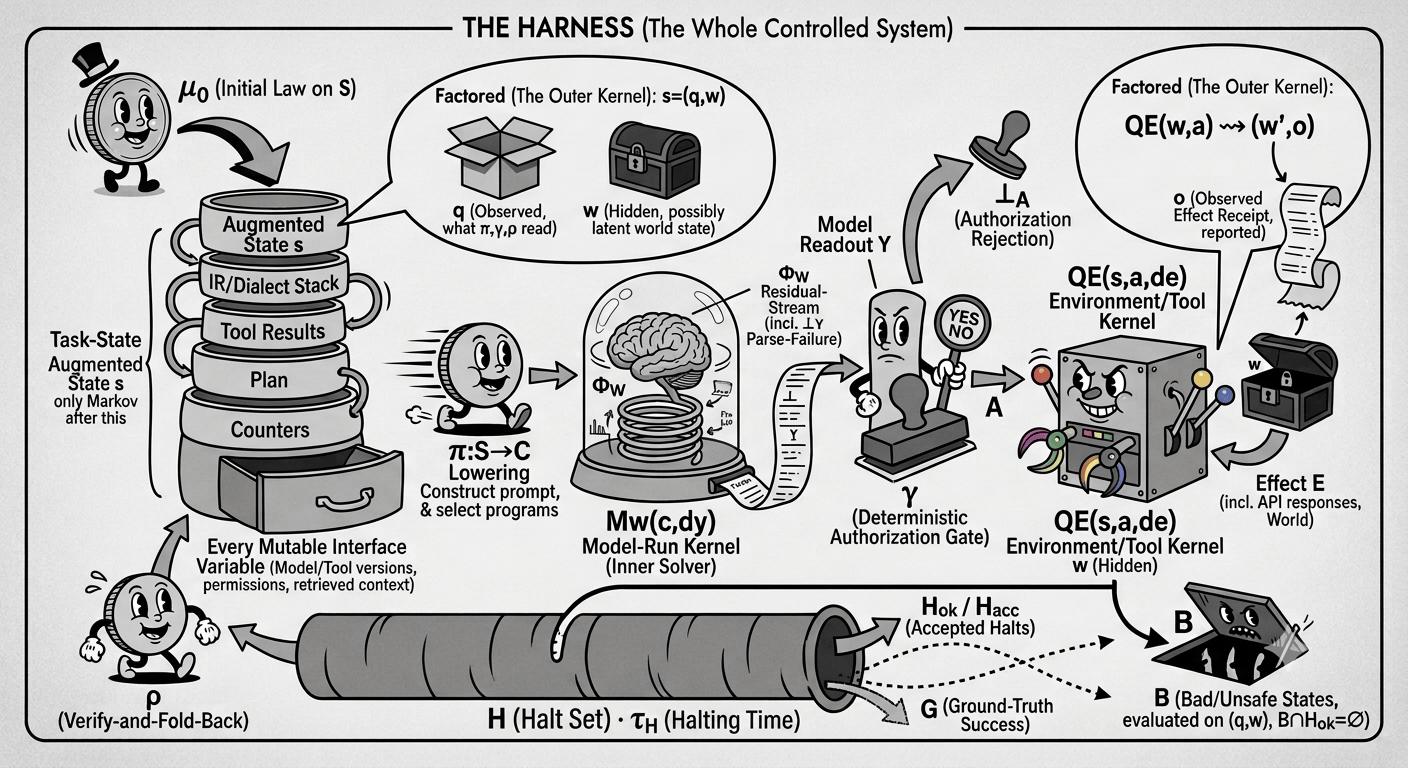
ℋ : s_{n+1} ~ T(s_n) for n < τ_H
the primer → · the formalism →
Release Tracks
| Track | Install | Docker | Description |
|---|---|---|---|
| Stable | pip install turnstone |
ghcr.io/turnstonelabs/turnstone:stable |
Production-grade. Bugfixes only. |
| Experimental | pip install turnstone --pre |
ghcr.io/turnstonelabs/turnstone:experimental |
New features. May have rough edges. |
See docs/releasing.md for the full release process.
What it does
Turnstone gives LLMs tools — shell, files, search, web, planning — and orchestrates multi-turn conversations where the model investigates, acts, and reports.
- Local-first & private — runs entirely on hardware you control, with no telemetry and no phone-home. Point it at local models (vLLM, llama.cpp) or commercial APIs you hold the keys to — your prompts and data never transit a third party you didn't choose.
- Bring your own models — OpenAI-compatible APIs (vLLM, llama.cpp, NIM), the Anthropic Messages API, and Google Gemini, mixed freely per role
- Interactive sessions — terminal CLI or browser UI with parallel workstreams
- Cluster dashboard — real-time view of every node and workstream, with a rendezvous routing proxy
- Intent validation — an LLM judge (your model) grades every tool call with a risk assessment and evidence before it runs
- MCP support — external tool servers with native deferred loading (Anthropic/OpenAI) or BM25 fallback
- Team controls when you need them — optional RBAC, SSO, tool policies, and audit logs, all stored in your own database

Quickstart
pip install turnstone

# Terminal REPL
turnstone --base-url http://localhost:8000/v1

# Browser UI
turnstone-server --port 8080 --base-url http://localhost:8000/v1

# Cluster dashboard
turnstone-console --port 8090
For PostgreSQL (recommended for production):
export TURNSTONE_DB_BACKEND=postgresql
export TURNSTONE_DB_URL="postgresql+psycopg://user:pass@localhost:5432/turnstone"
turnstone-server --port 8080 --base-url http://localhost:8000/v1
Docker
One-line install — autodetects Ubuntu/Debian, Fedora/RHEL, Arch, and WSL, installs git + Docker if missing, generates secrets, and starts the stack:
curl -fsSL https://raw.githubusercontent.com/turnstonelabs/turnstone/main/run.sh | bash
Or, if you already have Docker, clone the repo and run it yourself:
docker compose up
That builds one image and brings up a full local cluster — PostgreSQL, console,
Caddy, channel gateway, and 10 server nodes — with no .env required (it ships
with insecure dev defaults). Open the dashboard at https://localhost:8443 (Caddy
serves it over TLS with its own local CA — trust it once). Nodes boot without an
LLM; add model backends from the console UI.
For production (released images from ghcr.io, real secrets required), use the
bundled stack: docker compose -f turnstone/deploy/compose.yaml up.
See QUICKSTART.md for the install + troubleshooting walkthrough and docs/docker.md for Docker configuration.
Programmatic (SDK)
from turnstone.sdk import TurnstoneServer

with TurnstoneServer("http://localhost:8080", token="tok_xxx") as client:
    ws = client.create_workstream(name="demo")
    result = client.send_and_wait("Analyze the error logs", ws.ws_id, auto_approve=True)
    print(result.content)
Tools
Built-in tools for shell, files, search, web, memory, notifications, and autonomous sub-agents — plus external tools via MCP with native deferred loading. See docs/tools.md for the full reference and docs/mcp-registry.md for MCP configuration.
Architecture
Single-node: Client → Server (direct HTTP + SSE). No external dependencies beyond the database.
Multi-node: Client → Console (rendezvous routing proxy) → Server nodes. The console picks the target node for each workstream via rendezvous (HRW) hashing over the live service registry — pure function of (ws_id, live_nodes), no stored bucket state, deterministic across readers. A node join or drop only re-routes the keys that score highest on the affected node.
| Component | Purpose |
|---|---|
turnstone |
Terminal CLI (REPL) |
turnstone-server |
Web UI + REST API + SSE events |
turnstone-console |
Cluster dashboard + routing proxy + admin panel |
turnstone-channel |
Channel gateway (Discord and Slack adapters) |
turnstone-admin |
User/token management CLI |
turnstone-eval |
Headless measurement — scores tool-use against expected actions |
turnstone-optimizer |
Prompt/tool optimizer (UCB self-modify loop over the eval substrate) |
turnstone-doctor |
LLM-backed cluster diagnostics |
Diagrams
UML diagrams in docs/diagrams/:
| Diagram | Description |
|---|---|
| System Context | Components and external dependencies |
| Package Structure | Python modules and dependency graph |
| Core Engine | SessionUI, ChatSession, LLMProvider |
| Conversation Turn | Message lifecycle through the engine |
| Tool Pipeline | Prepare / approve / execute |
| Workstream States | State machine transitions |
| Console Data Flow | Dashboard data collection |
| Deployment | Docker Compose topology |
| Auth | JWT, scopes, login flows |
| Channels | Discord / Slack adapters + routing |
| Judge | Intent validation pipeline |
| OIDC | SSO authorization code flow |


Documentation
| Topic | Link |
|---|---|
| Configuration reference | docs/settings.md |
| API reference | docs/api-reference.md |
| Docker deployment | docs/docker.md |
| Intent validation (judge) | docs/judge.md |
| Governance & RBAC | docs/governance.md |
| OIDC SSO | docs/oidc.md |
| TLS / mTLS | docs/tls.md |
| Channel integrations | docs/channels.md |
| Console dashboard | docs/console.md |
| Eval harness | docs/eval.md |
| Tools reference | docs/tools.md |
| MCP integration | docs/mcp-registry.md |
Requirements
- Python 3.11+
- An OpenAI-compatible API endpoint, Anthropic API key, or Google Gemini API key
- Optional: Discord / Slack channel integrations (
pip install turnstone[discord,slack]) - Git LFS for cloning (diagram PNGs)
Support
Turnstone is free, Apache-2.0, and self-hosted — no paid tier, no telemetry, no upsell. If it saves you time or you'd like to help keep development moving, you can sponsor the project:
❤ Sponsor Turnstone → · one-off via PayPal
Sponsorship is entirely optional and funds maintenance, new features, and infrastructure. Prefer to contribute in other ways? Filing issues, improving docs, and pull requests help just as much.
Community
Questions, ideas, or want to show what you're building? Join us on Discord: discord.gg/Nh3bWMacaq.
License
Apache License 2.0, as of version 1.6.0. Versions 1.5.x and earlier remain under the Business Source License 1.1 they shipped with.