 Patrick Buckley
480a1426b3
Patrick Buckley
480a1426b3
* fix(session): fail-closed history-commit handoff (#981)

The deleted-workstream discovery is now a terminal, ws_id-keyed latch:
keyed conversation commits refuse admission once the durable parent is
gone (convergence finalizers and force-abandon are exempt), history
handoff refuses to mint a proof token so /history fails closed with a
503 instead of silently wiping the pane, and the SSE stream carries a
workstream_gone resync reason. Discarded commits leave a forensic log
of commit keys and roles, never content.

Conversation rows gain a commit_key (migration 071): keyed saves are
idempotent under retry, validated against the full commit identity, and
refused when they would cross a workstream deletion. The prune orphan
category now requires a NULL alias plus a two-hour updated grace, with
cutoffs computed at discovery time and carried into both dialects'
rechecks.

The mid-turn interjection queue is owner-partitioned with no per-site
mode flags: pops take the acting principal's and unowned rows, other
participants' rows are structurally retained, and enforcement lives at
queue admission plus the shared before_spawn gates. The retraction
ledger is bounded by open pop windows: pops open a window atomically
with the queue delete, restores close their ids atomically with the
ledger consume, every other exit closes through one helper, and misses
for unheld ids record nothing. The workstream-gone latch refuses
unattended wakes at all three gates (watcher spawn, claim, delivery
pre-pop), and the retry dispatcher regained its pre-envelope
cancel/error convergence net.

Persistence-state reporting derives through the session bound to each
UI instead of a registry lookup by id that failed open to healthy
during tombstone retention. The dashboard roster no longer re-inserts
ghost entries from trailing activity events, the history tool-outcome
scan tolerates interleaved non-turn rows, and the shared
handoff-deadline handle owns its own retirement.

Single-sourced across call sites: keyed-commit row values, attachment
save wrappers, tail-truncation and conflict-resolution bodies for both
storage dialects; worker-slot lifecycle field sets; the direct-commit
admission frame; queued-row layout accessors; the string-aware comment
stripper shared by every JS harness suite.

Refs #981 #964

* fix(session): sweep handoff fixes to their sibling surfaces

The interactive replay loop treated a system row as a tool-batch
boundary, so every tool result after an interleaved row vanished from
that pane while the coordinator rendered the same history correctly.
Only a conversational turn ends the batch window now, matching the
shared outcome index.

Accepted user turns clear the composer's attachment chips on the same
viewer policy that settles optimistic bubbles rather than on having
matched a local bubble, so a workstream created with an upload no
longer keeps a chip for an attachment the create dispatch already
consumed. The coordinator's raced-Stop arm emits the stream-end hook it
inherits alongside the idle state, leaving no unfinalized bubble or
unflushed tool output. Ending a session surfaces a failure toast when
the request never lands or answers with a non-JSON body.

The per-second persistence reconcile now probes each session without
blocking: a workstream whose generation and handoff locks are held is
skipped until the next pass instead of contending the locks every
commit needs. The one-shot repair that gates workstream creation at
capacity keeps a definite probe — it has no next pass, and the sessions
likeliest to be contended are the ones whose unresolved journals
emptied its candidate list.

Single-sourced: the attachment lane builds its conversation row through
the shared commit-identity builder; the ordinary worker exit releases
its slot through the lifecycle owner; both operator surfaces snapshot
their counters through one non-consuming helper; the replay preamble
loses its per-kind wrappers and its config hook; the browser harness
suites share one brace walker; and each in-flight history attempt is
one record carrying both its abort controller and its deadline.

Refs #981 #964
Turnstone






Self-hosted, local-first orchestration for tool-using AI agents. Give LLMs real tools — shell, files, search, web — and run them across your own cluster with direct HTTP routing and interactive interfaces. Your code, your models, your data stay on hardware you control: no telemetry, no phone-home.

Named after the Ruddy Turnstone (Arenaria interpres) — a shorebird that flips stones to discover what's hiding underneath.
What is a harness?
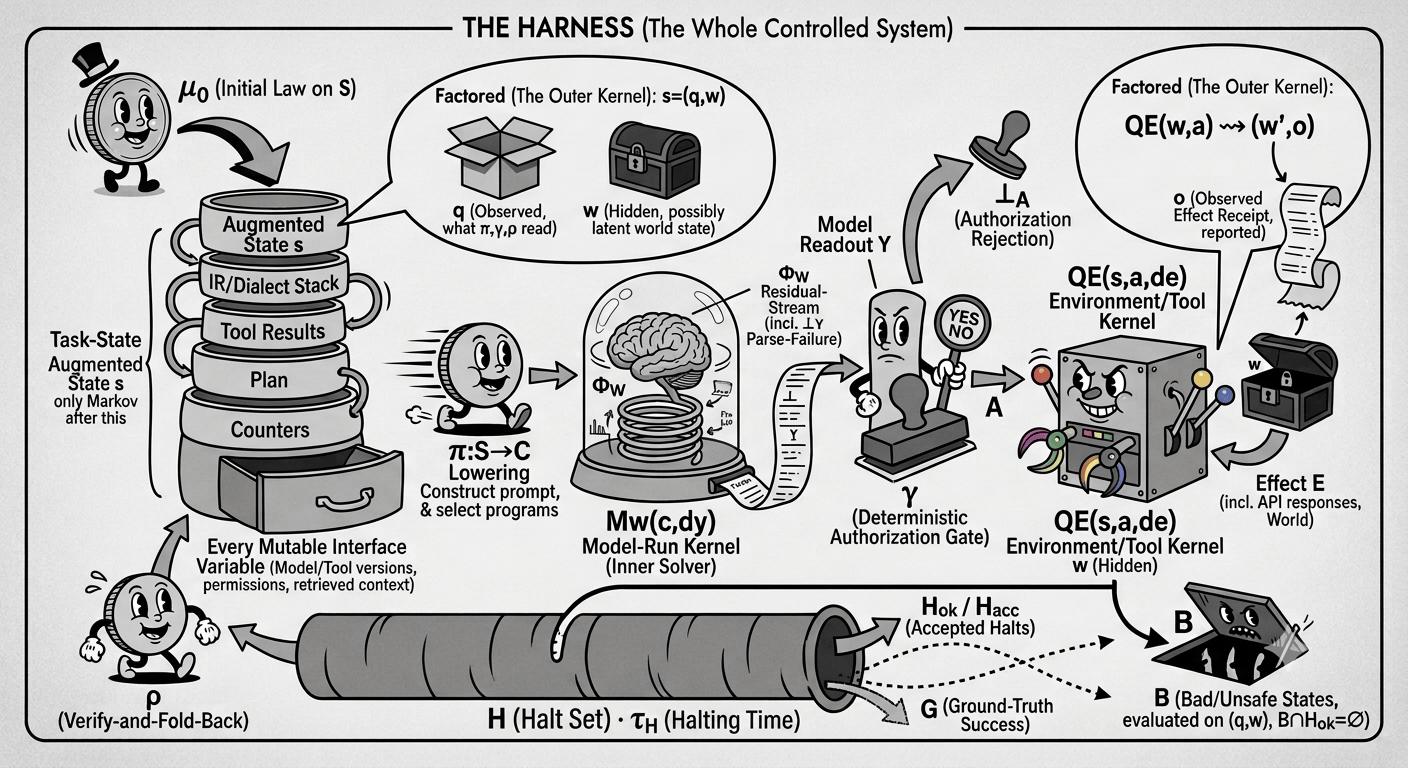
ℋ : s_{n+1} ~ T(s_n) for n < τ_H
the primer → · the formalism →
Release Tracks
| Track | Install | Docker | Description |
|---|---|---|---|
| Stable | pip install turnstone |
ghcr.io/turnstonelabs/turnstone:stable |
Production-grade. Bugfixes only. |
| Experimental | pip install turnstone --pre |
ghcr.io/turnstonelabs/turnstone:experimental |
New features. May have rough edges. |
See docs/releasing.md for the full release process.
What it does
Turnstone gives LLMs tools — shell, files, search, web, planning — and orchestrates multi-turn conversations where the model investigates, acts, and reports.
- Local-first & private — runs entirely on hardware you control, with no telemetry and no phone-home. Point it at local models (vLLM, llama.cpp) or commercial APIs you hold the keys to — your prompts and data never transit a third party you didn't choose.
- Bring your own models — OpenAI-compatible APIs (vLLM, llama.cpp, NIM), the Anthropic Messages API, and Google Gemini, mixed freely per role
- Interactive sessions — terminal CLI or browser UI with parallel workstreams
- Cluster dashboard — real-time view of every node and workstream, with a rendezvous routing proxy
- Intent validation — an LLM judge (your model) grades every tool call with a risk assessment and evidence before it runs
- MCP support — external tool servers with native deferred loading (Anthropic/OpenAI) or BM25 fallback
- Team controls when you need them — optional RBAC, SSO, tool policies, and audit logs, all stored in your own database

Quickstart
pip install turnstone

# Terminal REPL
turnstone --base-url http://localhost:8000/v1

# Browser UI
turnstone-server --port 8080 --base-url http://localhost:8000/v1

# Cluster dashboard
turnstone-console --port 8090
For PostgreSQL (recommended for production):
export TURNSTONE_DB_BACKEND=postgresql
export TURNSTONE_DB_URL="postgresql+psycopg://user:pass@localhost:5432/turnstone"
turnstone-server --port 8080 --base-url http://localhost:8000/v1
Docker
One-line install — autodetects Ubuntu/Debian, Fedora/RHEL, Arch, and WSL, installs git + Docker if missing, generates secrets, and starts the stack:
curl -fsSL https://raw.githubusercontent.com/turnstonelabs/turnstone/main/run.sh | bash
Or, if you already have Docker, clone the repo and run it yourself:
docker compose up
That builds one image and brings up a full local cluster — PostgreSQL, console,
Caddy, channel gateway, and 10 server nodes — with no .env required (it ships
with insecure dev defaults). Open the dashboard at https://localhost:8443 (Caddy
serves it over TLS with its own local CA — trust it once). Nodes boot without an
LLM; add model backends from the console UI.
For production (released images from ghcr.io, real secrets required), use the
bundled stack: docker compose -f turnstone/deploy/compose.yaml up.
See QUICKSTART.md for the install + troubleshooting walkthrough and docs/docker.md for Docker configuration.
Programmatic (SDK)
from turnstone.sdk import TurnstoneServer

with TurnstoneServer("http://localhost:8080", token="tok_xxx") as client:
    ws = client.create_workstream(name="demo")
    result = client.send_and_wait("Analyze the error logs", ws.ws_id, auto_approve=True)
    print(result.content)
Tools
Built-in tools for shell, files, search, web, memory, notifications, and autonomous sub-agents — plus external tools via MCP with native deferred loading. See docs/tools.md for the full reference and docs/mcp-registry.md for MCP configuration.
Architecture
Single-node: Client → Server (direct HTTP + SSE). No external dependencies beyond the database.
Multi-node: Client → Console (rendezvous routing proxy) → Server nodes. The console picks the target node for each workstream via rendezvous (HRW) hashing over the live service registry — pure function of (ws_id, live_nodes), no stored bucket state, deterministic across readers. A node join or drop only re-routes the keys that score highest on the affected node.
| Component | Purpose |
|---|---|
turnstone |
Terminal CLI (REPL) |
turnstone-server |
Web UI + REST API + SSE events |
turnstone-console |
Cluster dashboard + routing proxy + admin panel |
turnstone-channel |
Channel gateway (Discord and Slack adapters) |
turnstone-admin |
User/token management CLI |
turnstone-eval |
Headless measurement — scores tool-use against expected actions |
turnstone-optimizer |
Prompt/tool optimizer (UCB self-modify loop over the eval substrate) |
turnstone-doctor |
LLM-backed cluster diagnostics |
Diagrams
UML diagrams in docs/diagrams/:
| Diagram | Description |
|---|---|
| System Context | Components and external dependencies |
| Package Structure | Python modules and dependency graph |
| Core Engine | SessionUI, ChatSession, LLMProvider |
| Conversation Turn | Message lifecycle through the engine |
| Tool Pipeline | Prepare / approve / execute |
| Workstream States | State machine transitions |
| Console Data Flow | Dashboard data collection |
| Deployment | Docker Compose topology |
| Auth | JWT, scopes, login flows |
| Channels | Discord / Slack adapters + routing |
| Judge | Intent validation pipeline |
| OIDC | SSO authorization code flow |


Documentation
| Topic | Link |
|---|---|
| Configuration reference | docs/settings.md |
| API reference | docs/api-reference.md |
| Docker deployment | docs/docker.md |
| Intent validation (judge) | docs/judge.md |
| Governance & RBAC | docs/governance.md |
| OIDC SSO | docs/oidc.md |
| TLS / mTLS | docs/tls.md |
| Channel integrations | docs/channels.md |
| Console dashboard | docs/console.md |
| Eval harness | docs/eval.md |
| Tools reference | docs/tools.md |
| MCP integration | docs/mcp-registry.md |
Requirements
- Python 3.11+
- An OpenAI-compatible API endpoint, Anthropic API key, or Google Gemini API key
- Optional: Discord / Slack channel integrations (
pip install turnstone[discord,slack]) - Git LFS for cloning (diagram PNGs)
Support
Turnstone is free, Apache-2.0, and self-hosted — no paid tier, no telemetry, no upsell. If it saves you time or you'd like to help keep development moving, you can sponsor the project:
❤ Sponsor Turnstone → · one-off via PayPal
Sponsorship is entirely optional and funds maintenance, new features, and infrastructure. Prefer to contribute in other ways? Filing issues, improving docs, and pull requests help just as much.
Community
Questions, ideas, or want to show what you're building? Join us on Discord: discord.gg/Nh3bWMacaq.
License
Apache License 2.0, as of version 1.6.0. Versions 1.5.x and earlier remain under the Business Source License 1.1 they shipped with.